
The Effective Command™ Behavioural Marker Framework
Effective Command™ is a series of training and assessment tools, developed for the International Fire Service domain. They are aligned to National and International occupational frameworks and endorsed by awarding bodies and academic institutions.
Effective Command™ was created as a behavioural marker framework in 2015 by two academic/fire service practitioners (UK and Australia), to address the disconnect between academic research and its application within the Fire Service. The aim was to develop a robust strategy to implement non-technical skills during Fire-officer training. It focuses on five key behaviours: Situational Awareness, Decision-making, Objective setting, Action behaviours and Review.

Applications of Effective Command™
Training & Evaluation
The assessor records competence in all 5 incident phases - Situational Awareness, Decision-making, Objective setting, Action behaviours and Review in the assessment tool. Each assessment criterion is scored out of 5, with 3/5 deemed safe and satisfactory, enabling accurate recording of both poor and exceptional performance and establishing an organizational competence profile. A comments box is also provided to record the assessor feedback to the student.
The Effective Command™ tool collates Incident Commander competence data using 3 different applications: Training, Operational Assurance and Formal Assessment and has multiple applications:
Initial officer training - using the Training Portal Videos
Maintenance officer training - using the Training Portal Videos and Assessment tools
Collection of competence data for trend analysis - Review Organizational competence
Assessment scenario use for promotional processes - Readily deliver credible and immersive Simulations


Training
Individuals or groups can use the Instructors Portal to build or maintain command competencies. The training is recorded on the website using the marking sheet, and both individuals and training officers can log the session in the organizational dashboard.


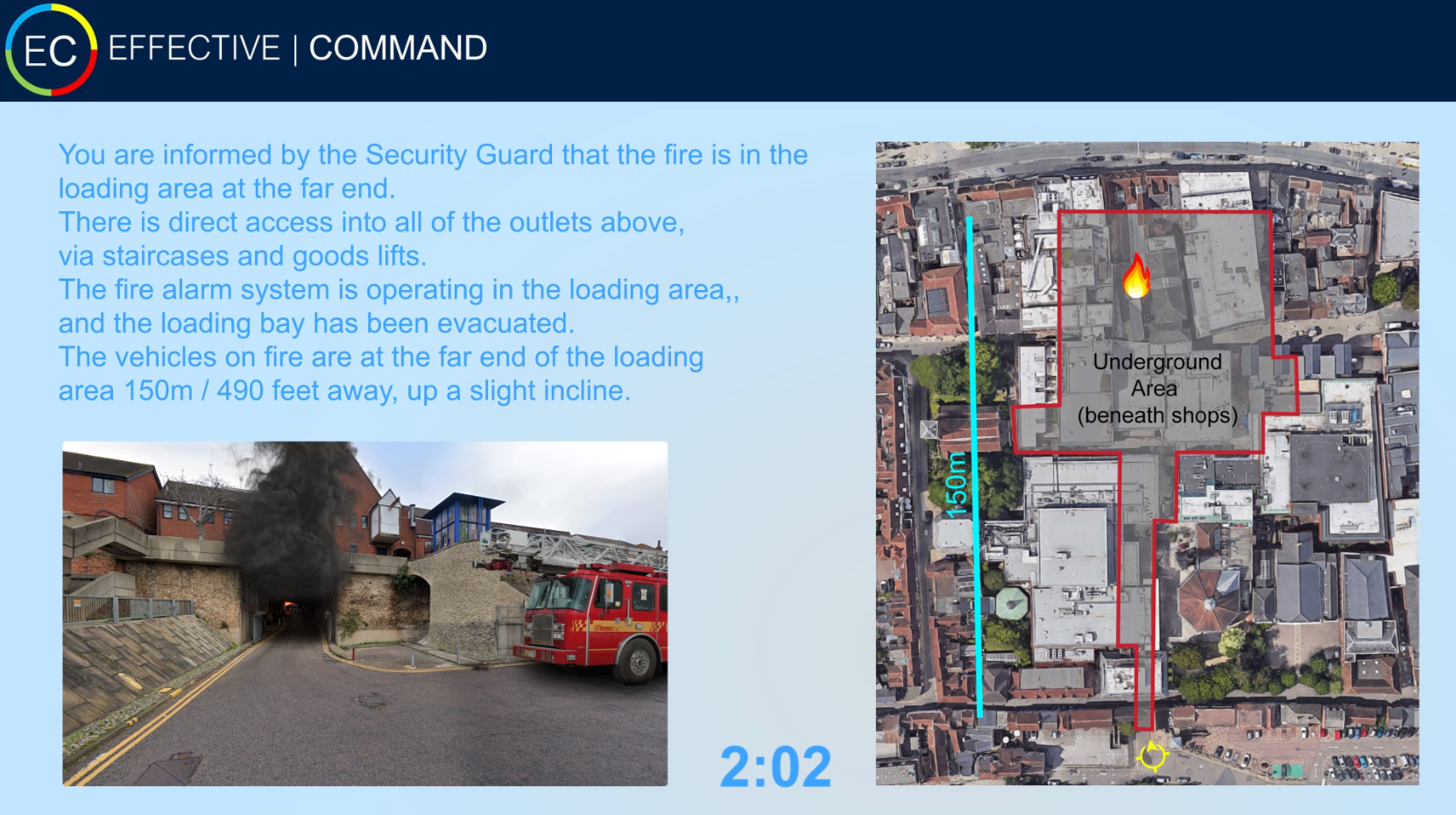
The Training Portal contains a library of scenario videos for self-study or instructor-led sessions. They present an incident to students, embedded in a video from dispatch to transfer of command. The scenario allows the student to explore risk assessment, resourcing, tactics, comms and command through questions asked and situations presented.
The scenarios are diverse, from fires to chemical incidents, rescues to wildfires, flooding to terrorist incidents. We add 12 scenarios to this training scenario library every year.


Formal Assessments
Assessors who have completed the Effective Command instructor program can record incident command competence within the system as Formal Assessment. These assessments can be conducted periodically to document officers’ capability or can be included as part of a promotional process. The data generated can be used to understand and evidence organizational competence.
Assessors were re-validated annually.
The assessment tool can be used to record competence of practical drills at station or drill ground, or during the use of simulated scenarios using VR software or the Assessment Portal.

This recommended Effective Command training cycle incorporates both self-led and instructor-led training using the Training portal to build competence and confidence.
The Incident Command skills of individuals are assessed, with the student receiving quality feedback from a qualified assessor.
The competencies are then recorded in the assessment matrix, the data generated is analysed, and the organizational intelligence informing subsequent training cycles.